

Capacitive vs Resistive Touch Screen 2025: Industrial Applications, EMI & Total Cost of Ownership
Quick Navigation:
Introduction: The 2025 Technology Choice

By 2025, capacitive (PCAP) touch technology leads most industrial projects, while resistive remains viable in niches where thick gloves, stylus input, or minimal budgets dominate.
Engineering teams selecting an HMI or industrial monitor must balance optical clarity, durability, EMI/ESD robustness, and total cost of ownership (TCO). This guide provides a side-by-side comparison of capacitive vs resistive touch screens, offers real-world application guidance, and gives a practical, standards-aligned checklist you can use during specification and supplier evaluation.
Context in 2025: Mini-LED backlights, improved AR/AF coatings, and mature optical bonding (OCA/OCR) further amplify PCAP's strengths in readability, service life, and sealing-especially for outdoor/medical/transportation scenarios.
Technology Fundamentals
Resistive Touch
Working Principle
Detects pressure when two conductive layers make contact through an air gap.
Touch Method
Any object: finger, stylus, or thick gloves.
Typical Use
Budget-constrained, single-touch workflows, legacy systems.
Capacitive Touch (PCAP)
Working Principle
Senses changes in electrostatic fields across a transparent electrode grid.
Touch Method
Conductive objects (finger) or tuned operation with gloves/special stylus.
Typical Use
Multi-touch HMIs, high uptime lines, outdoor/medical/transport systems.
Performance Comparison
| Parameter | Resistive | Capacitive | Advantage | Industrial Impact |
|---|---|---|---|---|
| Touch Accuracy | 85–90% | 98%+ | Capacitive | Precision control & fine UI elements |
| Multi-touch | Single point | 10+ points | Capacitive | Modern gestures; faster workflows |
| Lifespan | ~1M touches | 10M+ touches | Capacitive | Lower downtime & replacements |
| Light Transmission | 80–85% | 90–92% | Capacitive | Sunlight/readability advantage |
| Response Time | 10–20 ms | 3–8 ms | Capacitive | Snappier feel; faster inputs |
| Glove Operation | Excellent | Good (with tuning) | Resistive | Safety PPE; legacy workflows |
Environmental Suitability
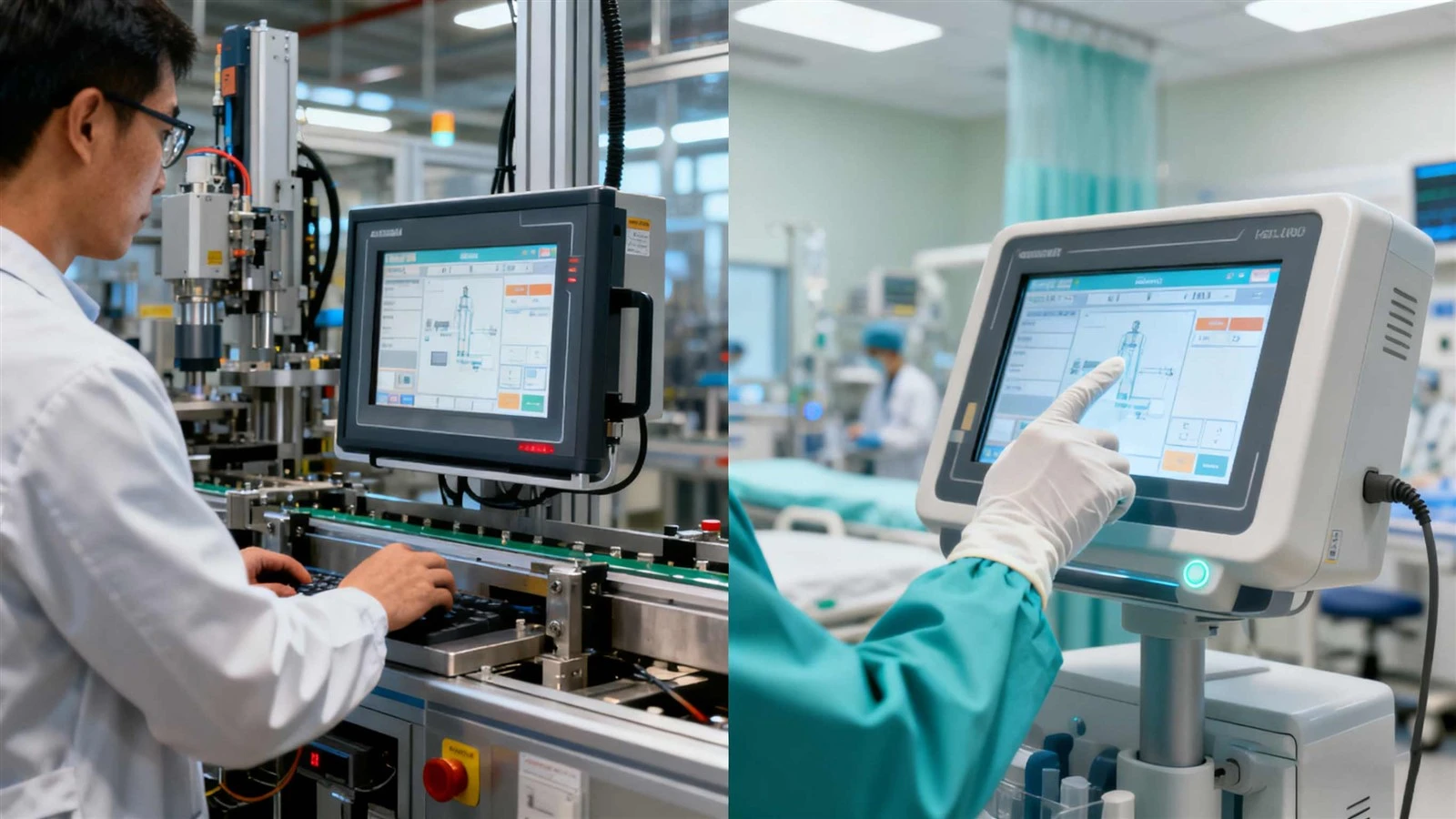
Industrial Automation
Capacitive Recommended
High uptime, multi-touch, robust sealing
Outdoor Kiosks / EV Charging
Capacitive + Bonding
High brightness + OCR/OCA bonding
Heavy PPE / Thick Gloves
Resistive Practical
Any stylus/object accepted
Strict Budget Projects
Resistive Advantage
Lower initial cost
EMI/ESD Performance & System Integration
EMI Immunity Headroom
PCAP typically achieves ~15 dB better rejection with proper shielding/grounding.
ESD Robustness
Well-designed PCAP survives contact/air discharges up to ±15 kV without re-calibration.
Integration Tips: Combine PCAP with ITO/silver mesh shielding, metal chassis bonding, filtered cables, and proper ground referencing. For noisy motor drives or high-power inverters, prefer optical bonding (OCR/OCA) + AR coating for both EMI stability and readability.
Standards & Compliance (Industrial & Medical)
General EMC/ESD
- EN 55032 / CISPR 32 (emissions)
- EN 55035 (immunity)
- IEC 61000-4-2 (ESD), -4-3 (RF), -4-4 (EFT), -4-5 (surge)
Medical & Special
- IEC 60601-1-2 (medical EMC)
- MIL-STD-461 (defense EMI)
- IP65/IP67 (dust/water) with bonded front glass
Cost & ROI Analysis
| Cost Factor | Resistive | Capacitive | Advantage |
|---|---|---|---|
| Initial Cost | $ (100%) | $$ (130–150%) | Resistive |
| Annual Maintenance | $$$ (High) | $ (Low) | Capacitive |
| Replacement Cycle | 2–3 years | 5–7 years | Capacitive |
| 5-Year TCO | $$$$ (100%) | $$ (60–70%) | Capacitive |
Optical Bonding Effect: OCR/OCA bonding often reduces reflections by ~35% vs air gap, boosting outdoor readability by ~25% and minimizing condensation-key for kiosks, EV charging, and marine consoles.
Case Studies (Before & After)
Medical Device Upgrade
Before (Resistive):
Frequent membrane replacements due to disinfectants; calibration drift; ~25% annual failure rate.
After (Capacitive + OCA):
Hardened glass, AF/AR coatings, higher accuracy; passed IEC 60601-1-2 with ~20 dB margin; 3-year zero-failure record.
EV Charging Network
Challenge:
Outdoor kiosks in coastal sun/salt/EMI exposure; vandal risk; condensation inside screens.
Solution:
PCAP + silver mesh shielding + OCR bonding + 1000–1500 nits + IP67 sealing + IK impact glass.
Result:
~99.5% uptime across 12 months; reduced service calls; improved user satisfaction.
Marine Navigation Retrofit
Before:
Resistive screens yellowed and delaminated in ~18 months due to UV + salt spray.
After:
PCAP + UV-filter glass + marine-grade sealing; field life extended to 5+ years.
Buying & Specification Checklist
Environment & Sealing
IP65/IP67, temp range, humidity, salt mist (IEC 60068-2-11) if coastal/marine.
Optical Performance
Brightness (800–1500 nits outdoors), AR/AF coatings, optical bonding (OCR/OCA).
Touch Behavior
Multi-touch, glove thickness, wet-finger tracking, response time, controller tunability.
EMI/ESD & Grounding
Shielding (ITO/mesh), chassis bonding, cable filtering; verify IEC 61000-4-2/-4-3 margins.
Lifecycle & Service
Spares policy, MTBF, warranty, controller firmware support, long-term availability.
Frequently Asked Questions
Q: Can PCAP work with thick industrial gloves?
A: Yes-modern controllers support glove tuning. Specify glove thickness/material in advance; we tune sensitivity and use AF coatings to maintain accuracy.
Q: Is resistive better for wet environments?
A: With optical bonding and waterproof front glass (IP65/IP67), PCAP is typically superior outdoors. For splashes with very thick gloves, resistive can still be practical.
Q: When should we choose resistive in 2025?
A: Legacy HMIs, ultra-low budgets, or workflows requiring any-object stylus with no multi-touch. For most new industrial builds, PCAP provides the best lifecycle value.
Related Guides
PCAP Touch Screen Shielding & Bonding 2025
EMI shielding options, OCA vs OCR, outdoor readability
Read Guide →Industrial Touch Screen Grounding Guide
Chassis bonding, cable filtering, ESD test strategies
Read Guide →Unsure Which Technology to Choose?
Our engineers analyze your environment, gloves/tools, and EMC constraints to recommend the most reliable, cost-effective option.
Get a data-driven recommendation with spec sheets, EMC notes, and bonding options tailored to your application.